The BMA is a union, and a union only survives if its members stay united. Its strength comes from solidarity — the belief that every doctor it represents stands on equal ground. Once that unity cracks, the union’s authority and negotiating power collapse with it. Over the past year, the BMA has allowed exactly that to happen.
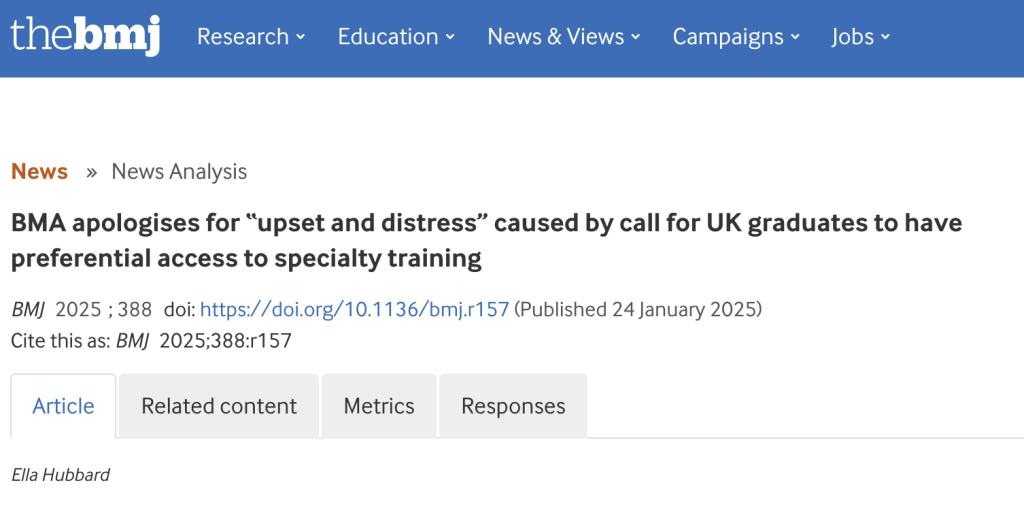
The real fracture didn’t begin with pay disputes or strike ballots. It began earlier, when the previous Resident Doctors Committee publicly lobbied for UK graduates to be prioritised for specialty training posts. Presented as a fix for rising competition ratios, it sent an entirely different message: thousands of IMG doctors suddenly realised their own union didn’t value them equally. A union cannot represent all resident doctors while openly elevating one group over another. That moment was the beginning of the unravelling.
What makes the committee’s decision even more disappointing is how illogical it was from the start — especially when far better alternatives were available. In a moment when competition ratios were exploding and the workforce was already stretched thin, the politically wise move would have been to unite doctors around a shared solution. Instead, the committee chose a stance that satisfied neither fairness nor strategy. Prioritising UK graduates wasn’t just divisive; it showed a lack of vision — a short-sighted response to a long-term structural problem.
Because if the real issue is too many applicants for too few training posts, the answer isn’t to rank people by birthplace or university. That doesn’t fix the bottleneck; it just shifts the frustration onto a different group while deepening internal resentment. A union should never respond to systemic pressures by turning its members against each other.
And that’s what makes the missed opportunity sting even more: a fair, logical, and strategically stronger alternative was sitting right there. Treating two years of actual NHS service as equivalent to being a UK graduate isn’t radical; it’s the most reasonable way to recognise competence, commitment, and contribution. If the system genuinely wants retention and workforce stability, valuing real experience over the postcode on someone’s medical diploma is the obvious place to start. Imagine if the BMA had lobbied for that instead — “Two years of NHS service = equal footing to UK grads.” IMGs would finally have a clear, fair path; more high-quality doctors would stay; fewer would leave for Australia or the Persian Gulf; and the NHS wouldn’t have to rebuild its workforce from scratch every August. It’s not just fair — it’s economically rational, morally consistent, and far more unifying.
But instead of choosing the path that united its members and strengthened its negotiating position, the BMA chose the one that divided them. It shot itself in the leg and then walked straight into industrial action with that injury.
By November 2025, as resident doctors prepared to strike, the union entered the dispute already weakened. Its authority wasn’t eroded by government pressure but by its own inconsistency. And that inconsistency gave the government the perfect opportunity to step in, exploit the division, and introduce policies that widened the cracks further. Nothing undermines a strike faster than a union that cannot guarantee its own members are behind it.
And that tragic irony by the committee is the true story behind the late-2025 strikes: a union going into a critical battle from its weakest position, not because the government outplayed it, but because it fractured itself.